SyntelliQ x
Industry News
Let’s talk Digital Transformation & Manufacturing in the context of the Asset Administration Shell (AAS)!
INTERVIEW BY GIORGOS PANTAZOPOULOS (Industry: Manufacturing).
Awraam Zapounidis about the future of Manufacturing.
02.07.2026
SYNTELLIQ
Production is learning to read itself.
Between machine signals, dashboards, reports, and day-to-day production decisions, a new domain is taking shape: Industrial intelligence that turns operations into insight — and insight into competitive advantage.
SYNTELLIQ explains how Industrial AI is changing the way a factory sees, understands, and improves itself.
INTERVIEW BY GIORGOS PANTAZOPOULOS
The point where technology meets day-to-day – operations on the factory floor, Industrial AI truly starts to matter.
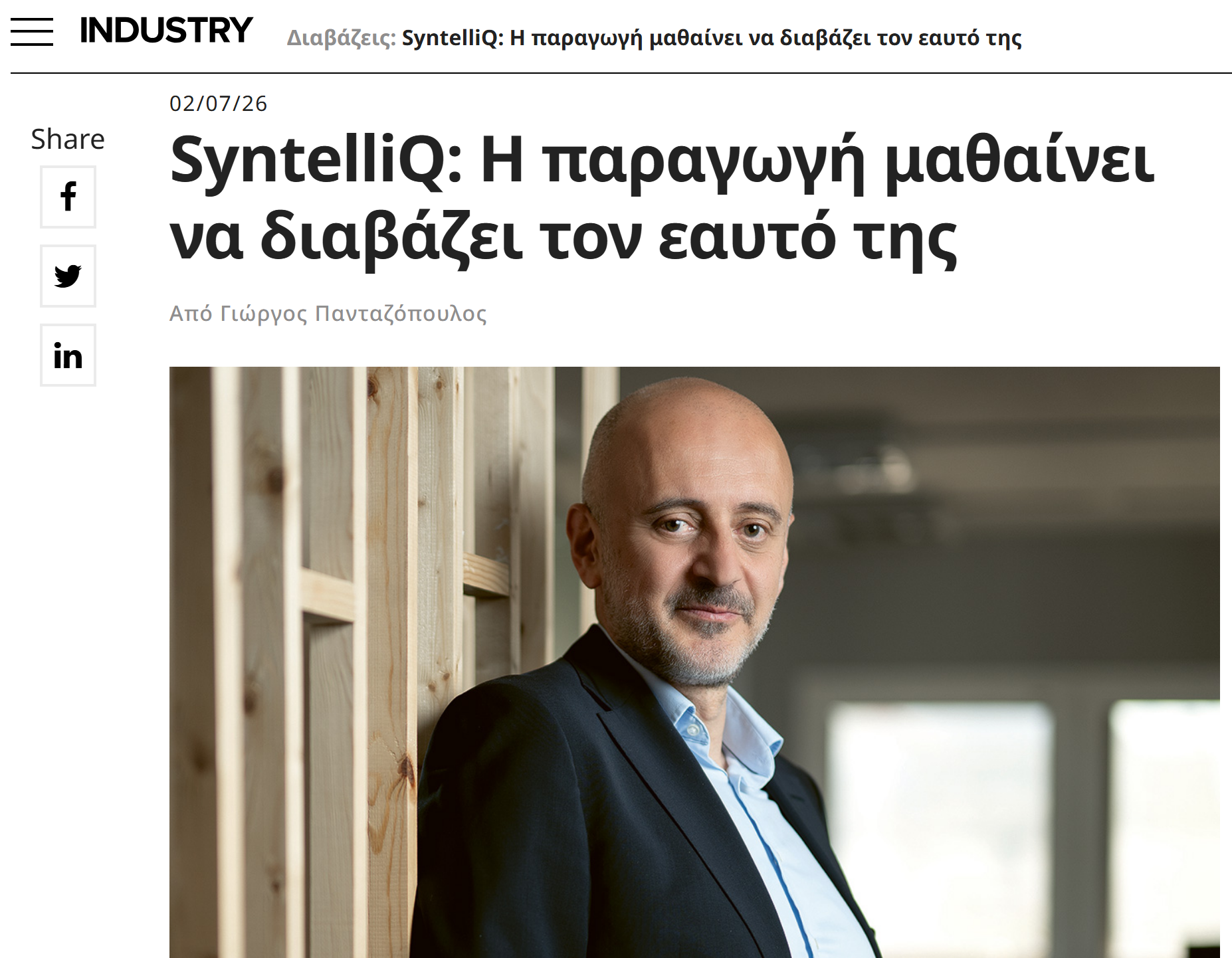
Awraam Zapounidis, CEO of SyntelliQ Group, talks about Industrial Intelligence, the Perfect Fuel methodology, the convergence of ET, OT, and IT, Digital Twins, and Industrial AI Agents – spotlighting an approach that connects industrial know-how with performance, energy, and decision-making.
“SyntelliQ describes itself as an “Industrial Intelligence Company.” What does that mean in practical terms for a factory?”
Industrial Intelligence doesn’t simply mean more technology inside the plant. It means using data in a way that turns it into real insight — and ultimately into better decisions.
SyntelliQ connects machines, processes, and people into a single, unified information environment. Every critical asset — from a pump to an entire production line — gets its own digital representation: a digital twin model that enables the business to understand not only what’s happening, but also why it’s happening — and what the next right move should be. Our goal isn’t to replace people; it’s to strengthen their role. To give them the tools to make decisions faster, with greater confidence, and with stronger financial results for plant operations.
„You describe “Perfect Fuel” as a methodology, not a product. What real problem is it designed to solve?“
The core issue Perfect Fuel tackles isn’t a lack of data. Today, most factories already generate massive volumes of data. The real challenge is how that data gets turned into coordinated, timely, and effective action. Often, operators, engineers, and leadership are looking at different versions of the same reality. That leads to delayed decisions, missed optimization opportunities, and operational inefficiencies. Perfect Fuel is the methodology that brings together data, people, and business objectives into a shared decision-making framework.
It turns machine signals into practical recommended actions and ensures that everyone — from the shop floor to management — operates from the same trusted view of reality.
„The convergence of ET, OT, and IT is often presented today as a prerequisite for any serious Industrial AI project. In practice, where does this chain usually “break” inside a factory?“
In a factory, the chain usually doesn’t break at the technology, but in a shared understanding of the data. OT systems record what’s happening on the equipment. IT systems manage business and operational information. Engineers deeply understand how the process behaves. But too often these three layers don’t truly communicate, creating information silos and solutions that don’t support a full view of operations. True convergence of ET, OT, and IT happens when everyone works from a shared operational model — a model where every event in the plant is directly tied to production, cost, performance, and ultimately the company’s goals.
„What’s the biggest misconception you see today in industry about artificial intelligence?“
The biggest misconception is that artificial intelligence is here to replace people. In industrial settings, the reality is different. AI can analyze huge volumes of data, spot patterns, and surface critical insights that would otherwise be difficult to use in time.
That allows people to focus on what they do best: assessing complex situations, making decisions, and managing demanding operational environments. The real value of AI comes when it strengthens human expertise and judgment — not when it tries to substitute for them.
“In the Greek industrial landscape, what’s currently the most mature area for applying Industrial AI?”
In Greece’s industrial landscape, the most mature application areas for Industrial AI are predictive maintenance and quality improvement driven by data, along with energy optimization. Across all three, there is accessible data, clear financial metrics, and immediate business value. Manufacturers can cut unplanned downtime, improve equipment availability, and strengthen production stability, while significantly reducing energy costs.
These are areas where ROI is measurable and can become visible in a relatively short timeframe — both in productivity and in profitability. That’s where the value lies: in results you can track and prove.
“What’s the difference between a plant that “has data” and a plant with true Operational Intelligence?”
A plant can collect massive amounts of data without necessarily being able to use it in a meaningful way. Operational Intelligence means turning data into timely, evidence-based, actionable decisions. It means the right information reaches the right person at the right time, with the operational context they need to act. So the difference isn’t the volume of information — it’s the quality of the data and the organization’s ability to convert it into higher performance, greater reliability, and stronger competitiveness.
“In energy-intensive industries, how does Industrial AI become a tool for energy competitiveness?”
In industries with high energy costs, Industrial AI can serve as a powerful lever for real energy competitiveness. Competitiveness, because it goes beyond simply tracking consumption. It links energy performance directly to the production process and helps the business understand where, when, and why energy is being used.
From analyzing consumption and spotting deviations, to real-time optimization and closed-loop control, Industrial AI’s value is primarily in enabling better decisions. When energy performance becomes part of day-to-day operations — not just a monthly report — the business gains a real competitive edge. Energy stops being a cost we merely monitor and becomes a lever we actively manage, with a direct impact on productivity, efficiency, and profitability.
“Your collaboration with Optimitive focuses on advanced process control and AI-driven optimization for energy and process performance. Which industries do you see delivering the most immediate value?”
The most immediate value shows up in energy-intensive sectors with complex, continuous processes — such as cement, metals, chemicals, refining, and power generation. In these environments, even small operating improvements can have a meaningful impact on energy cost, production stability, and overall efficiency.
Optimitive’s advanced process control technology, powered by AI-driven algorithms, can optimize hundreds of parameters at once and in real time — something that’s practically impossible to achieve manually. The result is lower energy use, more stable output, and faster payback on the investment.
“How does the role of the Digital Twin change when it’s connected to AAS, Data Spaces, and Industrial AI Agents?”
When a Digital Twin is connected to AAS, Data Spaces, and Industrial AI Agents, it stops being just a monitoring tool and becomes an active decision-making hub. The Asset Administration Shell gives the asset a standardized digital identity and ensures interoperability, regardless of specific vendors or systems. Data Spaces enable secure, governed data sharing across companies, systems, and partners throughout the value chain. Industrial AI Agents add the layer of analysis, prediction, and recommended actions. As a result, the Digital Twin takes on a much more meaningful role. It doesn’t just show what’s happening — it can support decisions, activate collaboration, and help build truly intelligent industrial operations.
“Industrial AI Agents are quickly becoming a key part of the conversation. Where can they be used safely today in an industrial setting?”
Today, the safest and most mature use of Industrial AI Agents is in-decision support. They can spot anomalies, analyze likely root causes of failures, recommend aintenance actions, and support operators with well-documented recommendations. In this way, they act as an extra layer of intelligence that supports plant operations without taking control away from people. In critical production operations, the final decision must remain with the human. Our philosophy is clear: Human in the Loop, Human Responsible for the Outcome.
The real value of AI comes when it serves as a force multiplier for human experience and judgment not as a replacement for them.
About Industry News: Manufacturing